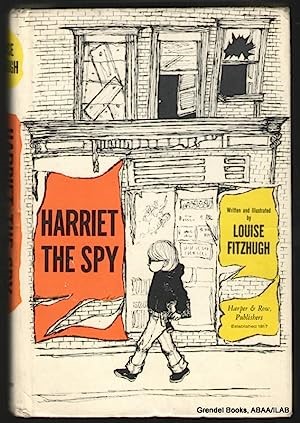
Mary Grace and Deborah discuss Harriet the Spy, Louise Fitzhugh’s 1964 classic about an 11-year-old would-be writer, her spying career, and her interactions with her nanny, her classmates, and her parents. You can listen to the episode here.
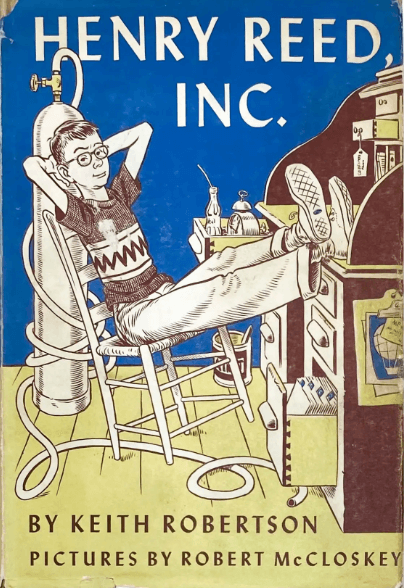
On the third episode of Rereading Our Childhood, Mary Grace and Deborah discuss Henry Reed, Inc., Keith Robertson’s 1958 novel about a boy who starts a research business while spending the summer with his aunt and uncle in a small town in New Jersey. This is the first in a five-book series about the adventures of Henry and his friend Midge. You can read this episode here.
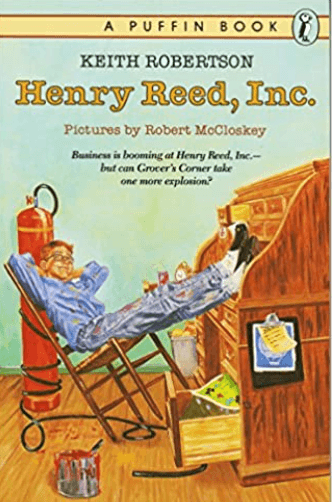
Here’s the cover of the current Puffin edition. This edition includes Robert McCloskey’s original illustrations, but the cover illustration, from 1989, is by Melodye Rosales. Obviously it’s an adaptation of the original cover, with updated clothes (though the loafers and white socks are a debatable choice), more dangerous chair position, etc.
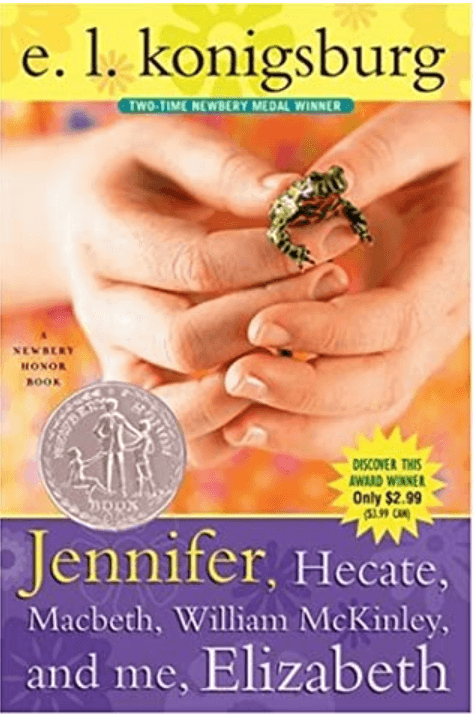
Jennifer, Hecate… is narrated by Elizabeth, a fifth grader who has just moved to a suburb of New York. She has no friends until she meets Jennifer, who says she’s a witch and offers to train Elizabeth as her apprentice. A series of challenges ensues (one week, for example, Jennifer has to eat a raw onion every day), and Elizabeth also faces the more common challenges of dealing with her teachers and classmates. In this episode, Debby and Mary Grace discuss witchcraft, race, childhood friendships, and the pronunciation of “Hecate.”
Konigsburg’s second novel, From the Mixed-Up Files of Mrs. Basil E. Frankweiler, was also published in 1967. It won the Newbery award in 1968, and Jennifer Hecate… was a runner-up. She is the only writer ever to have won both honors in the same year.
Debby and Mary Grace mentioned these other books by E.L. Konigsburg:
(George), about a boy in Florida who thinks that a little man named George lives in his head.
A Proud Taste for Scarlet and Miniver, the life of medieval queen Eleanor of Aquitaine as narrated by people close to Eleanor as they wait for her to join them in heaven.
Kongisburg and her family were living in the suburban town of Port Chester, New York, when she write Jennifer, Hecate. The town Jennifer and Elizabeth live in is based on Port Chester. As Mary Grace mentioned, Konigsburg’s children faced harassment because they were Jewish. Laurie Konigsburg Todd, discusses this in an interview in a Smithsonian Magazine article commemorating the fiftieth anniversary of From the Mixed-Up Files.
Here are some covers of various editions of Jennifer, Hecate:
This is the 50th anniversary edition, which replicates the first edition cover.
This is the cover of the paperback edition Debby and Mary Grace read as children (they both still have their copies), featuring Jennifer, Elizabeth, and their toad, Hillary Ezra.
This is the cover of a recent paperback edition, which, as Mary Grace mentioned, has been criticized for “erasing” Jennifer, who is African-American.
Here’s a Puffin edition with the abridged British title.
Mary Grace mentioned that a well-known British author criticized E.L. Konigsburg’s long titles. The author, John Rowe Townsend, is quoted in this article as calling the titles “gimmicky” and “an irritation” .
Here are the books that Debby and Mary Grace recommended for fans of Jennifer Hecate:
The Egypt Game, by Zilpha Keatley Snyder, about a group of children in Berkeley, California, who perform ancient Egyptian rituals. Is it just a game, or something more?
Harriet the Spy, by Louise Fitzhugh, the classic story of Manhattan girl who spies on her neighbors and records her observations about them, and about her classmates, in her journal.
And, lastly, here’s Merriam-Webster’s definition of Hecate, with pronunciations. Bottom line: Debby and Mary Grace are both right!
In the first episode of Rereading Our Childhood, Mary Grace and Deborah revisit Are You There God? It’s Me, Margaret, Judy Blume’s classic 1970 novel about adolescence. You can listen to this episode here.
Are You There God? It’s Me, Margaret is narrated by Margaret, a sixth-grader who has just moved from New Jersey to New York. Margaret’s father is Jewish and her mother was brought up Christian and she is being raised without a religion, which leaves her wondering where she fits in. Meanwhile, she and her friends are preoccupied with bras and boys and are eagerly waiting to get their periods. In this episode, Mary Grace and Deborah discuss the impact of Are You There God? It’s Me, Margaret and Blume’s other books on their own adolescent selves and how the book held up on rereading. They also talk about the Judy Blume moment currently underway, with a feature film of Are You There God? It’s Me, Margaret and the Amazon Prime documentaryJudy Blume Foreverrecently released, and about Blume’s activism against book banning.
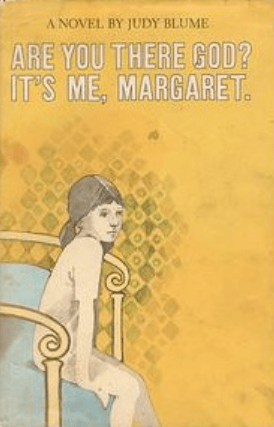
As Mary Grace and Deborah discuss, different covers over the years have presented Margaret in different ways, from the pensive girl sitting on her bed on the original edition,
to the blond Margaret on the 1970s paperback edition, who looks nothing like the Margaret in the book,
to the current paperback edition, where Margaret is anachronistically texting God on a cellphone (and he seems to be writing back),
to the movie tie-in with Margaret adjusting her shoe, presumably from the scene where she gets blisters walking to school without socks after her awful friend Nancy tells her that no one in sixth grade wears them.
Forever, the much-banned book about a teenage sexual relationship
As Mary Grace and Deborah discuss, Judy Blume’s books are often banned. An April 2023 PEN America report includes Blume’s novel Forever… on a list of books that have recently been removed from school libraries in the United States.
Here’s the New York Times article Mary Grace mentioned about the Judy Blume book-to-screen moment currently underway. (Clarification: It’s from the business section.)
As Mary Grace notes, Judy Blume demonstrated the famous “I must, I must, I must increase my bust” exercise on a TV program (HuffPost Live).
Recommended for fans of Are You There God? It’s Me, Margaret:
Freaky Fridayby Mary Rodgers, the hilarious story of a New York teenager who wakes up and discovers she’s been turned into her mother
The Long Secret by Louise Fitzhugh, the sequel to Harriet the Spy and one of the few books from the era other than Are You There God? It’s Me, Margaret to feature a girl getting her first period
If you haven’t had enough discussion of Margaret’s adolescent travails, there’s a great segment on the book on First Edition, a new podcast from the always interesting Book Riot team. They also have a substack critiquing the book’s covers.







 Rereading Our Childhood