(You can listen to this episode here. Please note that it is not suitable for children due to discussion of violent incidents that take place in the book.)
On this episode, Mary Grace and Deborah discuss The Egypt Game, Zilpha Keatley Snyder’s 1967 Newbery Honor Book about a group of children in a California university town who create an elaborate game based on ancient Egypt.
Mary Grace and Deborah ring in 2024 with a special episode where they count down their five favorite books from 50 years ago, defined as published between 1972 and 1974. They (mostly) didn’t reread these books for the episode, so their choices are based on their childhood memories.
As Mary Grace mentions, the format was inspired by the Book Riot podcast, which has done a number of similar countdowns, including a fun episode on the top bookish phenomena of the past 25 years.
Here are Deborah’s and Mary Grace’s favorites–but we suggest that you listen to the episode before looking at the list!
Hi, Mary Grace here! Rereading Our Childhoodis taking a break this week and will be back in January with a special episode. In the meantime, we’re looking back on some high points and not-so-high points of the year—or, rather, the half year, since we started in May—and counting down our top 10 episodes.
High Points
Revisiting our childhood favorites. Some of our rereads, like Harriet the Spy, lived up to our childhood memories. Others, like Pippi Longstocking, not so much. All of them, though, gave us a lot to think and talk about.
Learning about children’s writers. It’s been fascinating to learn about the lives of the writers of the books we’ve revisited. Who knew that a satirical article by Pippi Longstocking author Astrid Lindgren is credited with contributing to the defeat of the political party that had been in power in Sweden for 40 years? Or that Mary Rodgers, who wrote Freaky Friday, was in love with Stephen Sondheim and came fairly close to marrying him? Well, a lot of people, probably, but we didn’t.
Connecting with each other. Deborah and I live in different parts of the world for most of the year—she’s in Washington, D.C., and I’m in Cape Town—and it’s been fun to have a project that keeps us connected when we’re thousands of miles apart.
Connecting with other children’s book lovers. One of the best things about doing the podcast has been hearing from people on Facebook, Twitter, and BlueSky*—both friends and people we’ve never met—who loved the same books as children that we did.
Not-So-High Points
Technology. The learning curve on starting a podcast turned out to be steeper than I expected—way harder, for example, than starting a blog, which Deborah and I have both also done. As the vastly underqualified technical half of the team, I had to learn all about microphones, podcast platforms, recording software, etc.…and then figure out how to make it all work. I won’t bore you with the details, but there were definitely some bumps along the way. It’s gotten much smoother over time, though, and our editor, Adam Linder at Bespoken Podcasting, has been a lifesaver.
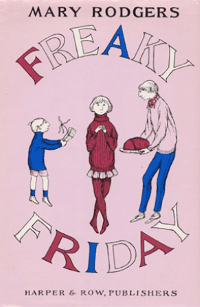
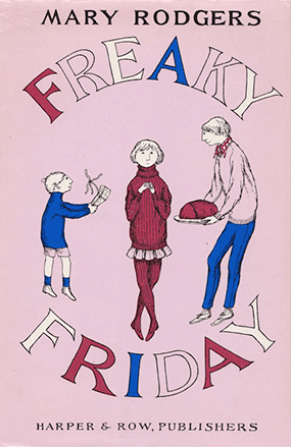
Harmful, outdated ideas. It wasn’t a surprise to find racism, sexism, colonialism, and other outdated ideas in books from half a century ago, but it hasn’t been pleasant to see so much of this type of content in the books that we loved as children. As you’d expect, there was more in older books, like the stereotypical depiction of Native Americans in Carol Ryrie Brink’s 1935 Caddie Woodlawn, than in more recent books like Mary Rodgers’ Freaky Friday(1971), which has a character saying racist things that the author portrays negatively but that, even so, wouldn’t make it into a book today.
Lack of diversity. Almost all of the characters in the books we read were white (one exception was E.L. Konigsburg’s Jennifer in Jennifer, Hecate, Macbeth, William McKinley, and Me, Elizabeth, who is African American), as were all of the authors. This situation has changed for the better since the 1970s, although authors and characters of color are still underrepresented.
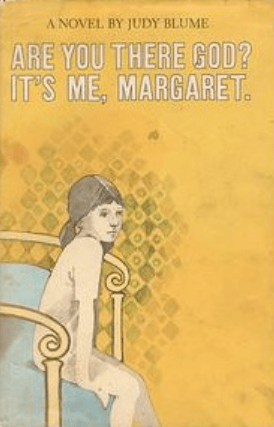
Book banning. We first dealt with this issue on our first episode, about Are You There God? It’s Me, Margaret by Judy Blume. Blume had five books, including this one, on the American Library Association’s list of the top 100 most challenged books of the 1990s. For Banned Book Week in October, we discussed Madeleine L’Engle’s 1962 science fiction classic A Wrinkle in Time, which was also on the list. And, unlike with stereotyping and lack of representation, this situation has gotten worse in recent years. A few unsuccessful attempts to get a book removed from a school library could get it onto the 1990s list. Today, large numbers of books are being removed following challenges, sometimes from just a single parent, or new legislation. Fortunately, opponents of book banning have had some recent successes as well.**
The Top 10
On a cheerier note, here are our 10 most downloaded episodes of the year:
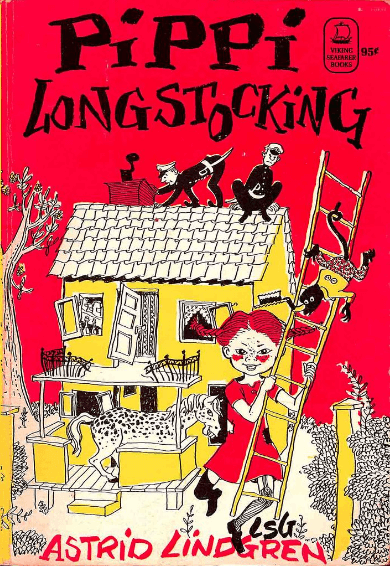
We discussed Astrid Lindgren’s 1945 book about a young girl who lives on her own and causes havoc wherever she goes on our most recent episode. It was one of our weirder rereads—we were taken aback, for example, when Pippi shot off a gun—but I had recently visited Sweden and was fascinated to learn about Lindgren’s prominence there (she’s even on the money).
Madeleine L’Engle’s 1962 classic A Wrinkle in Time is about…well, it’s hard to describe what it’s about. A troubled girl. A missing father. A genius brother. Three mysterious women. Interplanetary adventure. An evil, throbbing brain. None of this does justice to a book that, as science fiction-hating girls, we ended up loving, and, as grown-ups, we had a wonderful time returning to.
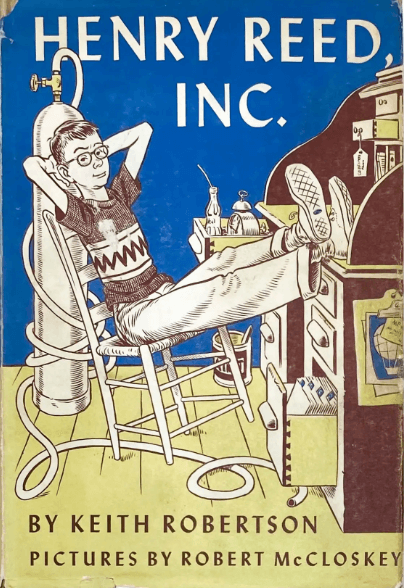
Keith Robertson’s 1958 novel about a boy who starts a research business while spending the summer with his aunt and uncle in a small town near Princeton, New Jersey, was a favorite of both of ours as children and a fun reread. This is the first in a five-book series about the adventures of Henry and his friend Midge.
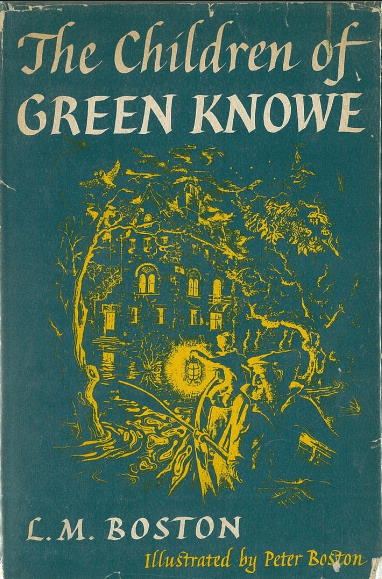
Oops! I made a mockery of the show title by picking a book that it turns out I probably didn’t read as a child. What I actually did read (and Deborah did too) was one of its sequels, The RIVER at Green Knowe. Nevertheless, we had a great time discussing the first book in the series, which is about a boy named Tolly who goes to live with his great-grandmother in a mansion haunted by seventeenth-century children. It was well written but kind of plotless. As we know from having been in a book group together for decades, though, not-so-good books often make for the best discussions, and that was the case this time.
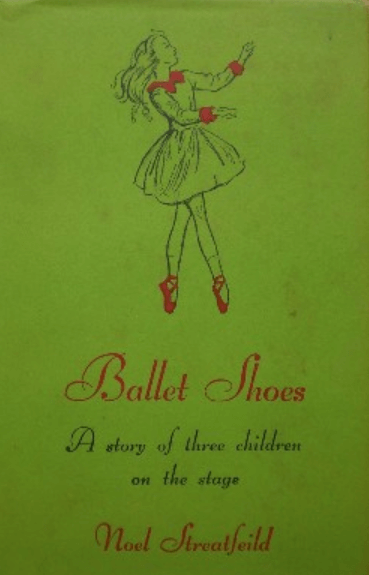
Noel Streatfeild’s 1936 classic tells the story of a trio of adopted sisters, Pauline, Petrova, and Posy, who attend a school for professional children in the performing arts in London. It’s light on plot and heavy on details about being a child performer, but the details were so interesting that we didn’t mind. Ballet Shoes is the first in what became a series about children working in the theater, the circus, etc.
E.L. Konigsburg’s first novel, the story of two friends who study witchcraft, was one of the few novels of the 1960s to feature an African-American character. It was a Newbery Honor Book the same year that Konigsburg’s second novel, From The Mixed-Up Files of Mrs. Basil E. Frankweiler, won the Newbery Medal. Konigsburg is a favorite of both of ours, and we had fun returning to her debut.
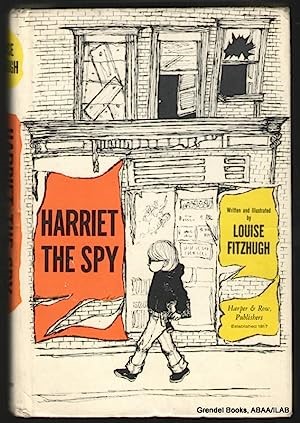
Louise Fitzhugh’s 1964 classic about a troubled 11-year-old would-be writer and her interactions with her nanny, her classmates, and her parents is wonderfully written and psychologically complex. Of all of our rereads, this one holds up best as a work of literature.
Published in 1963, this is the first of Donald J. Sobol’s 29-book series featuring Encyclopedia, the boy detective who always gets his man (or boy, or girl). On this episode, Deborah and I matched wits with Encyclopedia—and with each other—in identifying the culprits.
Alan Garner’s Carnegie Medal-winning 1967 novel The Owl Service tells the story of three teenagers who find themselves reliving a Welsh legend of love and betrayal that plays out over the generations. I remembered being haunted by this book as a child (Deborah hadn’t read it), and I chose it thinking, “No one’s going to listen to this episode, but I really want to talk about this book.” Its popularity was a mystery until I discovered that someone had posted a link on an Alan Garner Facebook fan site.
For our first episode, we revisited Blume’s classic 1970 story of an adolescent girl who is preoccupied with periods, bras, friendship, and religion. It remains by far our most popular episode, probably thanks to the movie. Blume herself is awesome (she owns a Florida bookshop! She’s an activist against book banning!), but I don’t, and didn’t as a child, find Margaret’s enthusiasm about adolescent rites of passage very relatable.
Happy holidays, everyone, and thanks so much to all of you for being part of our rereading adventures!
On this episode, Mary Grace and Deborah discuss Pippi Longstocking, Astrid Lindgren’s 1945 classic (published in English in 1950) about an anarchic Swedish girl. They discuss their love for the book as children, their mixed feelings on rereading it, and Pippi as a feminist icon. Mary Grace, who spent a month in Sweden earlier this year, talks about Lindgren’s legendary status in Sweden, where she’s literally on the money.
Mary Grace couldn’t find the interview with Lindgren’s daughter Karin, who one night when she was ill asked her mother to tell her a story about Pippi Longstocking, but Karin discussed it in this 2016 Guardian article.
In this episode, Mary Grace and Deborah reread one of their childhood favorites, Mary Rodgers’ 1972 mother-daughter body-switching story Freaky Friday. They also discuss Rodger’s posthumous 2022 memoir Shy, which was a New York Times Notable Book.
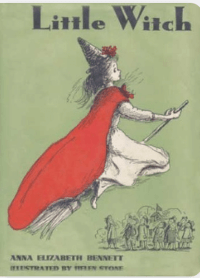
Deborah and Mary Grace celebrated Halloween by reading two books about witches, Little Witchby Anna Elizabeth Bennett, which was published in 1953, and The Little Leftover Witchby Florence Laughlin, which was published in 1960. Both books are about lonely little witches who find homes with non-magical families. Deborah had read both books as a child; both were new to Mary Grace.
Here’s the original cover of The Little Witch, with illustrations by Helen Stone. Two of Stone’s other books were selected as Caldecott Honor Books.
Here’s the original cover of The Little Leftover Witch, which gives you some idea of the illustrations by Sheila Greenwald, which Debby enjoyed as a child and missed in the current edition, which doesn’t have illustrations.
Other witch-related books mentioned on the episode:
On this episode, Mary Grace and Deborah reread Madeleine L’Engle’s 1962 classic A Wrinkle in TIme, about…well, it’s hard to describe what it’s about. A troubled girl. A missing father. A genius brother. Three mysterious women. Interplanetary adventure. An evil, throbbing brain. None of this does justice to a book that two science fiction-hating girls ended up loving, and that their grown-up selves had a wonderful time returning to.
Here’s the original cover, which perfectly captures its Cold War atmosphere:
On this episode, Deborah and Mary Grace discuss Ballet Shoes, Noel Streatfeild’s classic 1936 story of a trio of adopted sisters, Pauline, Petrova, and Posy, who attend a school for professional children in the performing arts in London. Ballet Shoes is the first in what became a series of “Shoes” books about children working in the theater, the circus, etc.
As Deborah and Mary Grace mention, the girls perform in these plays:
The Blue Bird, by Maurice Maeterlinck (a large chunk of which, weirdly, appears in the text of Ballet Shoes)
Other Noel Streatfeild books mentioned in the podcast:
Circus Shoes (1938). As Deborah mentions, several of Streatfeild’s books were retitled to capitalize on the popularity of Ballet Shoes. This book was originally titled The Circus is Coming.
Skating Shoes(1951). This is the American title; it was published in the UK as White Boots.
The Whicharts (1931). As Deborah mentions, Streatfeild’s first novel, which is for adults, also features three adopted sisters. (According to an episode on Ballet Shoeson the wonderful Backlisted podcast, the books have identical openings.)
Here’s the cover of the first edition of Ballet Shoes. This will give you an idea of the what the illustrations by Ruth Jervis, who was Streatfeild’s sister, were like. They’re not included in most current editions, although the Puffin edition that Mary Grace bought in London has them.
Recommended by Mary Grace for fans of Ballet Shoes: We Danced in Bloomsbury Squareby Jean Estoril (out of print, available from used booksellers).
Recommended by Deborah for fans of Ballet Shoes: other books in the Shoes series. Shoes books available in the United States include Theater Shoes and Dancing Shoes.
The podcast is hosted by Buzzsprout at rereadingourchildhood.buzzsprout.com and is available on Spotify, Apple Podcasts, and other podcast platforms. You can listen to it on Buzzsprout here.
Mary Grace and Deborah discuss Harriet the Spy, Louise Fitzhugh’s 1964 classic about an 11-year-old would-be writer, her spying career, and her interactions with her nanny, her classmates, and her parents. You can listen to the episode here.
On the third episode of Rereading Our Childhood, Mary Grace and Deborah discuss Henry Reed, Inc., Keith Robertson’s 1958 novel about a boy who starts a research business while spending the summer with his aunt and uncle in a small town in New Jersey. This is the first in a five-book series about the adventures of Henry and his friend Midge. You can read this episode here.
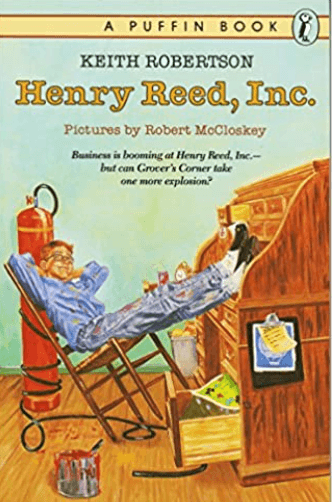
Here’s the cover of the current Puffin edition. This edition includes Robert McCloskey’s original illustrations, but the cover illustration, from 1989, is by Melodye Rosales. Obviously it’s an adaptation of the original cover, with updated clothes (though the loafers and white socks are a debatable choice), more dangerous chair position, etc.









 Rereading Our Childhood