Category Archives: Middle Grade

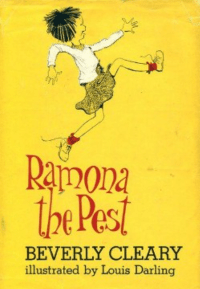
Rereading Ramona the Pest by Beverly Cleary

(You can listen to this episode here.)

Deborah and Mary Grace discuss Beverly Cleary’s 1968 classic Ramona the Pest. This was the first book starring Ramona, who appeared in Cleary’s earlier books as Beezus’s annoying little sister before going on to become Cleary’s most beloved character.

Mentioned in this episode:

Other books by Beverly Cleary:

Ellen Tebbits (1951)

Henry Huggins (1950)

Henry and Beezus (1952)

Mitch and Amy (1967)

Dear Mr. Henshaw (1983, winner of the 1984 Newbery Medal)

Other Rereading Our Childhood episodes:

Rereading “B” is for Betsy

Rereading A Wrinkle in Time

Rereading Are You There God? It’s Me, Margaret

Rereading Pippi Longstocking

Rereading Anne of Green Gables

Adaptations of the Ramona books:

Ramona and Beezus, 2010 movie

Ramona, 1988-89 Canadian TV series

Also mentioned:

Mike Mulligan and His Steam Shovel by Virginia Lee Burton (1939)

“Stereotypes in Beverly Cleary’s HENRY HUGGINS” on the blog American Indians in Children’s Literature, February 24, 2023

Beverly Cleary’s New York Times obituary, March 27, 2021

Madeleine L’Engle’s Austin Family series

Deborah Kalb’s The President and Me series

Recommended for Ramona fans: Anne of Green Gables (Mary Grace), The Mouse and the Motorcycle and other books by Cleary (Deborah)

The podcast is hosted by Buzzsprout at rereadingourchildhood.buzzsprout.com and is available on SpotifyApple Podcasts, and other platforms.

You can find Deborah’s author interviews on her blog, Books Q&A by Deborah Kalb, and Mary Grace’s adventures in the 1920s on her blog, My Life 100 Years Ago.

This episode was edited by Adam Linder of Bespoken Podcasting.

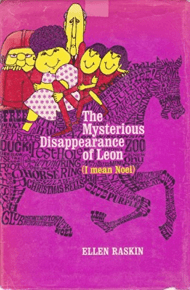
Rereading The Mysterious Disappearance of Leon (I Mean Noel) by Ellen Raskin

(You can listen to this episode here.)

Mary Grace and Deborah discuss Ellen Raskin’s 1971 mystery romp, The Mysterious Disappearance of Leon (I Mean Noel), about a woman’s decades-long search for her husband, whom she married as a child. (It’s a long story.) The book is full of word games, puzzles, and creative illustrations by Raskin, who was also a graphic artist.

Other books by Ellen Raskin:

Nothing Ever Happens on My Block (1967). This picture book, a childhood favorite of Mary Grace’s, was the first book Raskin wrote after illustrating many children’s books written by others.

Figgs and Phantoms (1974), a 1975 Newbery Honor Book.

The Westing Game (1978), winner of the 1979 Newbery Medal.

Also mentioned:

Raskin’s obituary in the New York Times (August 10, 1984).

A 2023 article in Allure about whether eating chocolate is bad for your skin.

The 2012 School Library Journal poll about the best children’s novels of all time, with The Westing Game at #9.

The Goodreads reviews of The Mysterious Disappearance of Leon (I Mean Noel) (highlight: Jeremy’s.)

Other Rereading Our Childhood episodes mentioned on this episode:

Rereading February’s Road by John Verney

Rereading Harriet the Spy by Louise Fitzhugh

Rereading Freaky Friday by Mary Rodgers

Rereading Misty of Chincoteague by Marguerite Henry

Rereading A Wrinkle in TIme by Madeleine L’Engle

Rereading Encyclopedia Brown, Boy Detective by Donald Sobol

The podcast is hosted by Buzzsprout at rereadingourchildhood.buzzsprout.com and is available on SpotifyApple Podcasts, and other platforms.

You can find Deborah’s author interviews on her blog, Books Q&A by Deborah Kalb, and Mary Grace’s adventures in the 1920s on her blog, My Life 100 Years Ago.

This episode was edited by Adam Linder of Bespoken Podcasting.

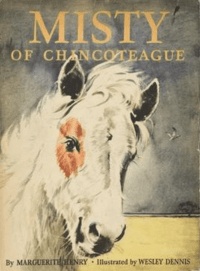
Rereading Misty of Chincoteague by Marguerite Henry

(You can listen to this episode here.)

Mary Grace and Deborah discuss Misty of Chincoteague, Marguerite Henry’s classic 1947 novel about Misty and her mother Phantom, wild ponies from the island of Assateague, and Paul and Maureen, a brother and sister from the neighboring island of Chincoteague who long to own them.

Other books by Henry:

Stormy, Misty’s Foal (1963)

Justin Morgan Had a Horse (1945), a Newbery Honor Book

King of the Wind (1948), winner of the 1949 Newbery Medal

Sea Star, Orphan of Chincoteague (1949)

Misty’s Twilight (1992)

Also mentioned on the podcast:

The life of Thomas Downing, the proprietor of the famous 19th-century restaurant Downing’s Oyster House, is discussed in “Going Deep into Oyster Country,” New York Times, December 3, 2021. Downing, who was African American, grew up in the Chincoteague community.

Recommended for fans of Misty of Chincoteague:

Mary Grace: Homecoming (1981) and Dicey’s Song (1982) by Cynthia Voight. These stories and later books in the series tell the story of Dicey and her siblings, who make their way to their grandmother’s home on Maryland’s Eastern Shore after their mother abandons them at a shopping mall in Connecticut. Dicey’s Song won the 1983 Newbery Medal.

Deborah: Stormy, Misty’s Foal (1963) and Sea Star, Orphan of Chincoteague (1949) by Marguerite Henry (1963). Misty appears in both books.

An obituary of Maureen Beebe, the real-life model for Maureen in the story, appeared in delmarvanow.com in May 2019.

You can learn more about the real-life Misty in “The True Story of Misty of Chincoteague, the Pony Who Stared Down a Devastating Nor’Easter,” Smithsonian Magazine, October 16, 2018. According to this story, the account in Misty of Chincoteague of the original Chincoteague ponies escaping to the island from a shipwreck is just a legend; more likely, they had been owned by 17th-century settlers.

The podcast is hosted by Buzzsprout at rereadingourchildhood.buzzsprout.com and is available on SpotifyApple Podcasts, and other platforms.

You can find Deborah’s author interviews on her blog, Books Q&A by Deborah Kalb, and Mary Grace’s adventures in the 1920s on her blog, My Life 100 Years Ago.

This episode was edited by Adam Linder of Bespoken Podcasting.

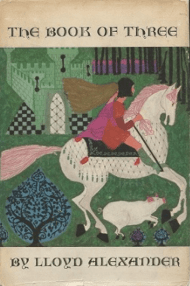
Rereading The Book of Three by Lloyd Alexander

(You can listen to this episode here.)

Mary Grace and Deborah discuss The Book of Three (1964), the first book in Lloyd Alexander’s five-book series The Chronicles of Prydain. Loosely based on Welsh mythology, the book chronicles the adventures of Taran, assistant pig-keeper to the oracular pig Hen Wen; Eilonwy, a strong-minded princess; and an entertaining cast of travel companions.

Other books in the series:

The Black Cauldron (1965), a Newbery Honor Book

The Castle of Llyr (1966)

Taran Wanderer (1967)

The High King (1968), winner of the 1969 Newbery Medal

Other books by Lloyd Alexander:

Time Cat (1963). (Deborah discussed Time Cat on a blog post on her favorite children’s books featuring time travel.)

And Let the Credit Go (1955), Alexander’s first novel, based on his experience working in a bank

Janine is French (1960)

The Wizard in the Tree (1974)

Park Avenue Vet (1960)

Fifty Years in the Doghouse (1964)

The King’s Fountain (1971), illustrated by Ezra Jack Keats

Also mentioned on the episode:

A 2012 School Library Journal poll on the best children’s novels, with The Book of Three at #18 and The High King at #68

Sam, Banks, and Moonshine, the Caldecott Medal-winning picture book by Evaline Ness, who illustrated the covers for the original editions of the Prydain Chronicles

Trailer of the Disney movie The Black Cauldron, based on The Book of Three and The Black Cauldron

2010 Slate article on the movie The Black Cauldron

Recommended for fans of The Book of Three:

Deborah: A Wrinkle in Time (discussed on a previous episode), The Phantom Tollbooth (discussed on a previous episode)

Mary Grace: The Owl Service (discussed on a previous episode), The Dark is Rising series

Mary Grace found a fellow The Book of Three fan at The English Bookshop, a wonderful bookstore in Uppsala, Sweden.

The podcast is hosted by Buzzsprout at rereadingourchildhood.buzzsprout.com and is available on Spotify, Apple Podcasts, and other platforms.

You can find Deborah’s author interviews on her blog, Books Q&A by Deborah Kalb, and Mary Grace’s adventures in the 1920s on her blog, My Life 100 Years Ago.

This episode was edited by Adam Linder of Bespoken Podcasting.

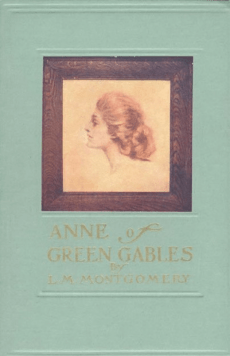
Rereading Anne of Green Gables by L.M. Montgomery

(You can listen to this episode here.)

Deborah and Mary Grace discuss Anne of Green Gables, L.M. Montgomery’s beloved tale of a strong-willed and imaginative orphan who goes to live with a pair of middle-aged siblings on Prince Edward Island.

Other books in the series:

Anne of Avonlea

Anne of the Island

Anne of Windy Poplars

Anne’s House of Dreams

Anne of Ingleside

The recently published book of stories Deborah mentions is The Blythes are Quoted.

Also mentioned on the episode:

Mary Grace read Anne of Green Gables during her year of reading as if she were living in 1918 and reviewed it here. It’s #37 on the list.

Anne is a prodigious reader. Here are some of the books and poems that she reads:

“Curfew Must Not Ring Tonight” by Rose Hartwick Thorpe

“The Lady of Shallot” by Alfred, Lord Tennyson. Mary Grace misquotes the poem, saying “The mirror crack’d from side to side/the DOOM has come upon me, cried/The Lady of Shallot,” instead of “the CURSE has come upon me,” repeating a misquotation by a character in Agatha Christie’s The Mirror Crack’d.

Ben Hur by Lew Wallace

“Marmion” by Sir Walter Scott

Mary Grace mentions the attractive Word Cloud Classics edition of Anne of Green Gables, which she read in 2018. Alas, the print was too small this time around, so she read it on her Kindle.

You can see the original illustrations by William and Mary Claus, which neither Deborah nor Mary Grace are a fan of, in this scanned copy on HathiTrust.

“Suicide Secret of Anne of Green Gables Author,” The Guardian, September 23, 2008.

Trailer for Netflix series Anne With an E

Little Women by Louisa May Alcott

Recommended by Mary Grace for fans of Anne of Green Gables: Pippi Longstocking by Astrid Lindgren

Recommended by Deborah for fans of Anne of Green Gables: Rebecca of Sunnybrook Farm by Kate Douglas Wiggin, Caddie Woodlawn by Carol Ryrie Brink

“Bosom Friends: Lesbian Desire in L. M. Montgomery’s Anne Books,” Laura Robinson, Canadian Literature, Spring 2004

“A Visual History of Romantic Friendship,” The Marginalian

The podcast is hosted by Buzzsprout at rereadingourchildhood.buzzsprout.com and is available on SpotifyApple Podcasts, and other podcast platforms.

You can find Deborah’s author interviews on her blog, Books Q&A by Deborah Kalb, and Mary Grace’s adventures in the 1920s on her blog, My Life 100 Years Ago.

This episode was edited by Adam Linder of Bespoken Podcasting.

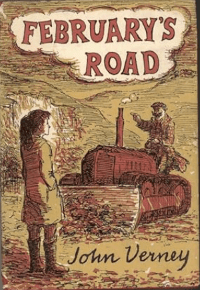
Rereading February’s Road by John Verney

(You can listen to this episode here.)

Mary Grace introduces Deborah to John Verney’s 1961 novel February’s Road. It’s the second volume in a series about the large and eccentric Callendar family. In this book, 13-year-old February Callendar unearths skullduggery involving plans to build a road through her family’s property.

Other books by John Verney mentioned on the episode:

Friday’s Tunnel (1959), also narrated by February.

Ismo (1964), told from the point of view of February’s sister Gail. It’s the only book in the series that’s told in the third person.

Seven Sunflower Seeds (1968), narrated by February’s younger sister Berry.

Samson’s Hoard (1973), also narrated by Berry. This book doesn’t seem to have been published in the United States and Mary Grace didn’t read as a child.

Going to the Wars (1955), Verney’s well-regarded memoir about his experiences in World War II.

A Dinner of Herbs (1966), the follow-up to Going to the Wars.

Also mentioned:

Mary Grace mentions The Arm of the Starfish (1965) by Madeleine L’Engle, which, like the Callendar family books, involves young people involved in international intrigue.

Mary Grace and Deborah talk about the word “zany,” used on the covers of our old copies of both February’s Road and (less accurately) Harriet the Spy, which we discussed on a previous episode.

You can check out Verney’s illustrations in an electronic copy of February’s Road on HathiTrust (it’s unclear why, since it’s still under copyright). The link goes to an illustration where February’s father is throwing the mail up in the air in disgust.

A post about February’s Road on the blog Clothes in Books, which includes a comment by Verney’s son Sebastian saying that the character Mike Spillergun’s name was a reference to the comedian Spike Milligan. (This post includes one of Mary Grace’s favorite passages, where February and her frenemy Helen are giving each other the once-over at a party.)

Several commentators have noted the similarity between Verney’s illustrations and those of Edward Ardizzone, a well-known British illustrations. The striking similarity can be seen in a self-portrait by Ardizzone.

Other art of Verney’s, along with a photograph of his family, can be found here.

Mary Grace mentions an obituary in The Independent that says that Verney could have been a significant artist if not for his experiences in World War II.

As Mary Grace mentions, Verney devoted much of his later life to work on historic preservation with the Farnham Trust. There is a post on the Farnham Trust’s website about a centenary lunch in honor of Verney. It includes a photograph of Verney’s wife, children, and grandchildren.

Mary Grace mentions that this is the third episode featuring a British writer who devoted a lot of time to historic preservation. The other episodes were on Alan Garner’s The Owl Serviceand L.M. Boston’s The Children of Green Knowe.

The writer Jojo Moyes said in a 2011 Daily Mail interview that Friday’s Tunnel was the book that first gave her the reading bug.  

Mary Grace says that, after reading the Callendar family books as a child, she went on to be a fan of Margaret Drabble’s early novels. Her favorite was The Millstone, published in 1965.

Deborah mentions Ballet Shoes, the subject of a previous episode, as one of her favorite British books when she was a child.

Mary Grace recalls how much she enjoyed the British words and expressions in Verney’s books as a child and bemoans the practice of adapting British books, including the Harry Potter books, for an American audience. This website provides a list of words and phrases that were changed in the Harry Potter books—“sweets” to “candy,” etc.

Mary Grace mentions the discussion on the episode on Pippi Longstockingon recent edits to that book’s text.

Deborah recommends the Madeleine L’Engle books to fans of February’s Road, since they take place in a similar time period and involve government secrets.She and Mary Grace discussed L’Engle’s classic A Wrinkle in Time on a previous episode.

Mary Grace says that fans of February’s Road may enjoy Nancy Mitford’s novels The Pursuit of Love and Love in a Climate when they are older, since both are about large, eccentric upper-class British families.

The podcast is hosted by Buzzsprout at rereadingourchildhood.buzzsprout.com and is available on SpotifyApple Podcasts, and other podcast platforms.

You can find Deborah’s author interviews on her blog, Books Q&A by Deborah Kalb, and Mary Grace’s adventures in the 1920s on her blog, My Life 100 Years Ago.

This episode was edited by Adam Linder of Bespoken Podcasting.

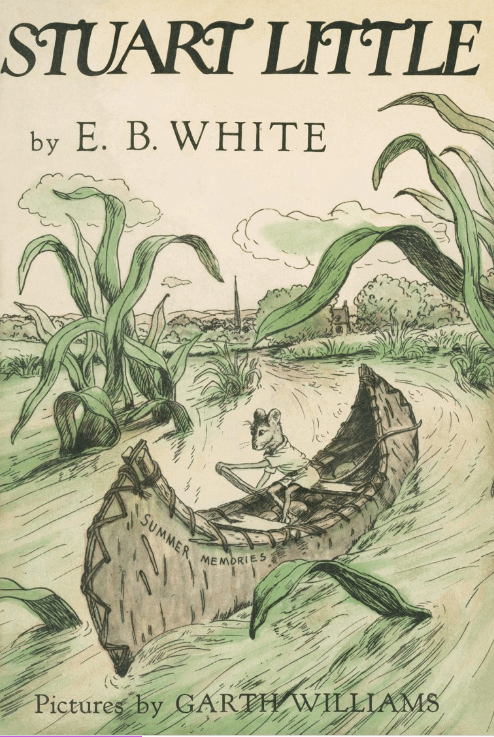
Rereading Stuart Little by E.B. White

(You can listen to this episode here.)

On this episode, Deborah and Mary Grace reread Stuart Little, E.B. White’s 1945 classic about the adventures of a New York boy who looks exactly like a mouse. They discuss their early memories of reading Stuart Little (or having it read to them), Garth Williams’ wonderful illustrations, and pioneering children’s librarian Annie Carroll Moore’s vehement opposition to the book.

Mentioned on this episode:

Charlotte’s Web by E.B. White

The Trumpet of the Swan by E.B. White

The Elements of Style by William Strunk Jr. and E.B. White

Essays of E.B. White

Letters of E.B. White

“Death of a Pig,” essay by E.B. White, The Atlantic (paywall). (Mary Grace erroneously recalled that this essay was about the birth of a pig.)

“Celebrating Children’s Book Week–and a pioneering librarian,” Mary Grace’s post on her blog, mylife100yearsago.com, about Annie Carroll Moore

The Rabbits’ Wedding, the children’s book by Stuart Little editor Garth Williams that was banned from Alabama libraries because a black and a white rabbit get married

“The Lion and the Mouse: The Battle that Shaped Children’s Literature” by Jill Lapore, The New Yorker, July 14, 2008

Stuart Little, 1999 movie (trailer)

The podcast is hosted by Buzzsprout at rereadingourchildhood.buzzsprout.com and is available on SpotifyApple Podcasts, and other podcast platforms.

You can find Deborah’s author interviews on her blog, Books Q&A by Deborah Kalb, and Mary Grace’s adventures in the 1920s on her blog, My Life 100 Years Ago.

This episode was edited by Adam Linder of Bespoken Podcasting.

Rereading The Phantom Tollbooth by Norton Juster

(You can listen to this episode here.)

On this episode, Mary Grace and Deborah discuss The Phantom Tollbooth, Norton Juster’s 1961 classic about Milo, a boy who’s bored with life until a mysterious tollbooth takes him and his electric car to The Lands Beyond, where he meets the warring kings of Dictionopolis and Digitopolis and many other memorable characters. Jules Feiffer’s numerous illustrations are as important a part of the story as the text.

This is the last episode of the season. We’ll be back in May.

Mentioned on this episode:

The Dot and the Line (1963), written and illustrated by Norton Juster

The Odious Ogre (2010) by Norton Juster, illustrated by Jules Feiffer

Harold and the Purple Crayon by Crockett Johnson

The New York Times Book Review podcast’s 2020 interview with Jules Feiffer, where he talks about his friendship and collaboration with Juster

Juster’s 2021 New York Times obituary

2015 Smithsonian Magazine  profile on Juster where he discusses his synesthesia

Recommended for fans of The Phantom Tollbooth:

Half Magic by Edward Eager

The Wizard of Oz by L. Frank Baum and the other Oz books

Alice’s Adventures in Wonderland by Lewis Carroll 

The podcast is hosted by Buzzsprout at rereadingourchildhood.buzzsprout.com and is available on SpotifyApple Podcasts, and other podcast platforms.

You can find Deborah’s author interviews on her blog, Books Q&A by Deborah Kalb, and Mary Grace’s adventures in the 1920s on her blog, My Life 100 Years Ago.

This episode was edited by Adam Linder of Bespoken Podcasting.

Rereading The Egypt Game by Zilpha Keatley Snyder

(You can listen to this episode here. Please note that it is not suitable for children due to discussion of violent incidents that take place in the book.)

On this episode, Mary Grace and Deborah discuss The Egypt Game, Zilpha Keatley Snyder’s 1967 Newbery Honor Book about a group of children in a California university town who create an elaborate game based on ancient Egypt.

Mentioned in this episode:

The Egypt Game: A Second Look, a 50-year retrospective published in The Horn Book in 2017

The 1967 Kirkus Review review of The Egypt Game

A 2011 post on the website Banned Reads Project where three teenagers give their perspectives on The Egypt Game

The ACLU’s list of The 100 Most Frequently Challenged Books of 1990-2000

The Waste Land by T.S. Eliot

The Love Song of J. Alfred Prufrock by T.S. Eliot

Other Rereading Our Childhood episodes:

Rereading Are You There God? It’s Me, Margaret by Judy Blume

Rereading Jennifer, Hecate, Macbeth, William McKinley, and Me, Elizabeth by E.L. Konigsburg

Rereading A Wrinkle in Time by Madeleine L’Engle

Rereading Half Magic by Edward Eager

Rereading The Owl Service by Alan Garner

Our Favorite Children’s Books from 50 Years Ago

Other books by Zilpha Keatley Snyder:

The Gypsy Game, the 1997 sequel to The Egypt Game

The Headless Cupid (1971), a Newbery Honor Book

The Witches of Worm (1972), a Newbery Honor Book

The Changeling (1970)

Eyes in the Fishbowl (1968)

Black and Blue Magic (1966)

Season of Ponies (1964)

Recommended for fans of The Egypt Game:

Jennifer, Hecate, Macbeth, William McKinley, and Me, Elizabeth, by E.L. Konigsberg (1967 Newbery Honor Book)

From the Mixed-Up Files of Mrs. Basil E. Frankweiler by E.L. Konigsburg (1967 Newbery Medal winner)

Magic or Not? by Edward Eager

The Well-Wishers by Edward Eager

The podcast is hosted by Buzzsprout at rereadingourchildhood.buzzsprout.com and is available on SpotifyApple Podcasts, and other podcast platforms.

You can find Debby’s author interviews on her blog, Books Q&A by Deborah Kalb, and Mary Grace’s adventures in the 1920s on her blog, My Life 100 Years Ago.

This episode was edited by Adam Linder of Bespoken Podcasting.

Rereading Danny Dunn and the Anti-Gravity Paint by Jay Williams and Raymond Abrashkin

(You can listen to this episode here.)

On this episode, Deborah and Mary Grace discuss Danny Dunn and the Anti-Gravity Paint, published in 1956. In the first book of the popular series, Danny discovers a secret rocket project and, oops, accidentally launches the rocket into space.

Discussed in this episode:

A 2023 New Yorker article about Danny Dunn

Other books in the series:

Danny Dunn and the Homework Machine

Danny Dunn and the Fossil Cave

As Deborah mentions, Danny Dunn and the Anti-Gravity Paint was illustrated by Ezra Jack Keats, who wrote and illustrated the Caldecott Award-winning picture book The Snowy Day.

For fans of Danny Dunn, Mary Grace recommends the Henry Reed series. We discussed Henry Reed, Inc., the first book in the series, on our third episode. Deborah recommends the Encyclopedia Brown books. The first book in the series, Encyclopedia Brown, Boy Detective, was discussed on our eighth episode.

The podcast is hosted by Buzzsprout at rereadingourchildhood.buzzsprout.com and is available on SpotifyApple Podcasts, and other podcast platforms.

You can find Debby’s author interviews on her blog, Books Q&A by Deborah Kalb, and Mary Grace’s adventures in the 1920s on her blog, My Life 100 Years Ago.

This episode was edited by Adam Linder of Bespoken Podcasting.