Category Archives: Historical Fiction

Rereading All-of-a-Kind Family by Sydney Taylor

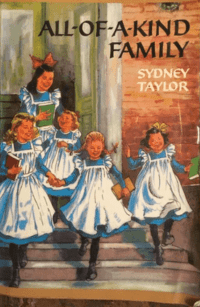
Cover of All of a Kind Family by Sydney Taylor, five girls in identical dresses on front steps of building.

(You can listen to this episode here.)

On this episode, we discuss All-of-a-Kind Family, Sydney Taylor’s 1951 classic about five sisters growing up on New York’s Lower East Side. Over the course of a year, the girls experience joys (like celebrating Jewish holidays and the Fourth of July) and sorrows (like getting scarlet fever and even worse losing a library book), and spend a lot of time thinking about how to spend their allowance (one penny).

Mentioned on this episode:

Other books in the series:

More All-of-a-Kind Family

All-of-a-Kind Family Uptown

All-of-a-Kind Family Downtown

Ella of All-of-a-Kind Family

Also mentioned:

Peter and Polly in Winter by Rose Lucia (1914), Sarah’s lost library book.

From Sarah to Sydney by June Cummins (a biography of Sydney Taylor)

Jennifer Weiner’s New York Times review of From Sarah to Sydney

One of a Kind: The Life of Sydney Taylor, a children’s picture book biography by by Richard Michelson (read Deborah’s interview with Michelson here)

Recommended for fans of All-of-a-Kind Family:

Deborah: Little Women by Louisa May Alcott

Mary Grace: The Saturdays by Elizabeth Enright, Meet Me in St. Louis by Sally Benson, Seven-Day Magic by Edward Eager

Other Rereading Our Childhood episodes mentioned:

Rereading The Saturdays by Elizabeth Enright

Rereading Little Town on the Prairie by Laura Ingalls Wilder

Rereading Half Magic by Edward Eager

The podcast is hosted by Buzzsprout at rereadingourchildhood.buzzsprout.com and is available on SpotifyApple Podcasts, and other platforms.

You can find Deborah at deborahkalb.com and Mary Grace’s adventures in the 1920s on her blog, My Life 100 Years Ago.

This episode was edited by Adam Linder of Bespoken Podcasting.
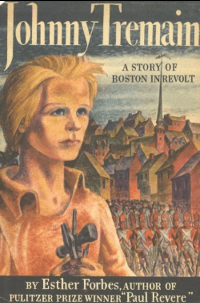
Cover of Johnny Tremain by Esther Forbes, Johnny in front of a view of Boston.

Rereading Johnny Tremain by Esther Forbes

(You can listen to this episode here.)

On this episode, we discuss Esther Forbes’ Newbery Medal-winning 1943 novel Johnny Tremain, the story of an apprentice silversmith in Boston who gets caught up in the events leading up to the American Revolution.

Mentioned on this episode:

Other books by Esther Forbes:

Paul Revere and the World He Lived In (1942), winner of the 1943 Pulitzer Prize for History.

The General’s Lady (1938)

Miss Marvel (1935)

Also mentioned:

The 1957 Disney movie adaptation of Johnny Tremain (trailer here)

Gadsby’s Tavern, in Alexandria, Virginia, which was built in 1770 and is now a museum and restaurant. Mary Grace went there with her sixth-grade class.

The Biggest Bear by Lynd Ward, illustrator of Johnny Tremain, which won the Caldecott Medal in 1953.

The American Antiquarian Society, of which Esther Forbes was the first woman member

Redcoat in Boston by Ann Finlayson

Recommended for fans of Johnny Tremain:

Mary Grace: Answering the Cry for Freedom: Stories of African Americans and the American Revolution by Gretchen Wolfe. (Deborah interviewed the author on her blog, Book Q&As with Deborah Kalb.) Mary Grace also mentions that there are several picture books about Revolutionary-Era African American scientist Benjamin Banneker. These include Dear Benjamin Banneker by Andrea Davis Pinkney, illustrated by Brian Pinkney.

Deborah: The Witch of Blackbird Pond by Elizabeth George Speare (1958)

Other Rereading Our Childhood episodes mentioned:

Rereading The Secret Garden by Frances Hodgson Burnett

Rereading The Witch of Blackbird Pond by Elizabeth George Speare

The podcast is hosted by Buzzsprout at rereadingourchildhood.buzzsprout.com and is available on SpotifyApple Podcasts, and other platforms.

You can find Deborah at deborahkalb.com and Mary Grace’s adventures in the 1920s on her blog, My Life 100 Years Ago.

This episode was edited by Adam Linder of Bespoken Podcasting.
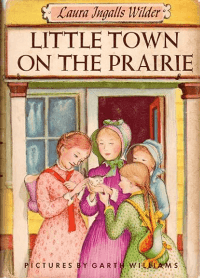
Rereading Little Town on the Prairie, with Judith Kalb

(You can listen to this episode here.)

We were delighted to welcome our first guest, Judith Kalb, to talk about Laura Ingalls Wilder’s Little Town on the Prairie (1941), the seventh book in the beloved Little House series. Judy is, in addition to being Deborah’s sister, a literature scholar and a lifelong Laura Ingalls Wilder fan.

Mentioned on this episode:

Other books in the Little House series:

Little House in the Big Woods (1932)

Little House on the Prairie (1935)

On the Banks of Plum Creek (1937)

The Long Winter (1940)

The First Four Years (posthumously published in 1971)

Also by Laura Ingalls Wilder:

Pioneer Girl: The Annotated Autobiography (written beginning in about 1930; published in 2014)

Also mentioned:

The Complete Poetical Works of Alfred Tennyson (This 1875 version, which says Tennyson’s Poems on the cover, matches the description of the Christmas present Laura finds hidden in her mother’s drawer.)

Stuart Little by E.B. White, illustrated by Garth Williams

Charlotte’s Web by E.B. White, illustrated by Garth Williams

The Beautiful Snow: The Ingalls Family, the Railroads, and the Hard Winter of 1880-81 by Cindy Wilson

Prairie Fires: The American Dreams of Laura Ingalls Wilder by Caroline Fraser

The TV adaptation of Little House on the Prairie. (Here’s the trailer for the remastered edition.)

Confessions of a Prairie Bitch: How I Survived Nellie Oleson and Learned to Love Being Hated by Alison Arngrim

A post on Little Town on the Prairie on the website American Indians in Children’s Literature criticizing the

Mary Grace expressed surprise that the phrase “lunatic fringe,” used by Pa to describe Laura’s bangs, dated back to the 1800. It turns out that this phrase originally referred to women’s bangs. Theodore Roosevelt is credited with its first political use, in a 1913 speech.

Recommended for fans of Little Town on the Prairie:

Judith: The rest of the Little House series, especially These Happy Golden Years

Mary Grace: Anne of Green Gables by L.M. Montgomery, Two are Better Than One and Louly by Carol Ryrie Brink

Deborah: Caddie Woodlawn by Carol Ryrie Brink

Other Rereading Our Childhood episodes:

Rereading Stuart Little by E.B. White

Rereading Caddie Woodlawn by Carol Ryrie Brink

Rereading Anne of Green Gables by L.M. Montgomery

The podcast is hosted by Buzzsprout at rereadingourchildhood.buzzsprout.com and is available on SpotifyApple Podcasts, and other platforms.

You can find Deborah at deborahkalb.com and Mary Grace at My Life 100 Years Ago.

This episode was edited by Adam Linder of Bespoken Podcasting.

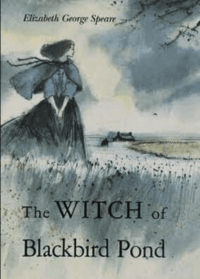
Rereading The Witch of Blackbird Pond by Elizabeth George Speare

(We’ve been publishing episodes regularly but have gotten behind on the website, so we’re catching up. This episode was published on October 17. It was our Halloween episode but, with its colonial American setting, it makes a good Thanksgiving episode as well. You can listen to it here.)

In this episode, Mary Grace and Deborah discuss Elizabeth George Speare’s 1958 Newbery Medal winner The Witch of Blackbird Pond, about a girl, Kit, who’s struggling to fit in in a Puritan community in colonial Connecticut.

Mentioned in this episode:

The Crucible, Arthur Miller’s 1953 play about the Salem witch trials, which was a commentary on McCarthyism.

Little Women by Louisa May Alcott. Kit’s cousin Mercy has Beth-like qualities.

Kit’s childhood reading includes The Pilgrim’s Progress and The Tempest.

The Bronze Bow, Speare’s 1962 Newbery Medal winner about a Jewish boy living at the time of Christ who converts to Christianity.

Calico Captive, Speare’s first novel, published in 1957, based on a real-life story about a girl who was captured by Native Americans in 1794 and taken to Canada.

The Sign of the Beaver, Speare’s 1983 Newbery Honor book about a boy struggling to live on his own in eighteenth-century Maine.

Calico Bush, Rachel Lyman Field’s 1931 novel about a French girl who works as an indentured servant in colonial Maine.

Speare’s 1989 Laura Ingalls Wilder Award citation.

Commentary on thestorygraph.com by a contributor using the name books_n_pickles who talks about the “love hexagon” in the book.

Goodreads reviews of The Witch of Blackbird Pond.

Recommended for fans of The Witch of Blackbird Pond: Johnny Tremain by Esther Forbes (Deborah), Nightbirds on Nantucket by Joan Aiken (Mary Grace).

Other episodes mentioned:

Rereading Black Hearts in Battersea by Joan Aiken

Rereading Caddie Woodlawn by Carol Ryrie Brink

The podcast is hosted by Buzzsprout at rereadingourchildhood.buzzsprout.com and is available on SpotifyApple Podcasts, and other platforms.

You can find Deborah’s author interviews on her blog, Books Q&A by Deborah Kalb, and Mary Grace’s adventures in the 1920s on her blog, My Life 100 Years Ago.

This episode was edited by Adam Linder of Bespoken Podcasting.
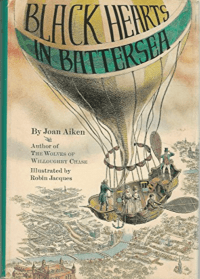
Rereading Black Hearts in Battersea by Joan Aiken

(You can listen to this episode here.)

Mary Grace and Deborah commemorate the 100th anniversary of British author Joan Aiken’s birth by reading Black Hearts in Battersea, the second in her Wolves Chronicles series, featuring resourceful orphans and sinister plots in an alt-history version of nineteenth-century London.

(Note: Mary Grace thought for fifty years that Dido Twite’s first name was pronounced DEE-doh rather than DIE-doh, and she slips back to this pronunciation a few times.)

Mentioned on the episode:

Other books in the Wolves Chronicles series:

The Wolves of Willoughby Chase

Nightbirds on Nantucket

Other books by Joan Aiken:

Jane Fairfax

Other Rereading Our Childhood episodes:

Rereading February’s Road by John Verney

Rereading The Mysterious Disappearance of Leon (I Mean Noel) by Ellen Raskin

Rereading Freaky Friday by Mary Rodgers

Rereading Ramona the Pest by Beverly Cleary

Rereading The Children of Green Knowe by L.M. Boston

Rereading The Owl Service by Alan Garner

Rereading The Book of Three by Lloyd Alexander

Also mentioned:

The Shortest History of England by James Hawes

Post on Black Hearts in Battersea on the blog A Son of the Rock (question King James’s Scottish accent)

“What’s Your 1918 Girl Job? A Quiz,” post on Mary Grace’s blog My Life 100 Years Ago that mentions Jane Fairfax. (Jane Fairfax also comes up on another post, “Jane Austen’s Life 100 Years Ago.”)

“Writing Without Limits: Joan Aiken’s The Wolves of Willoughby Chase Series,” Albion Magazine Online (discusses Aiken taking time to settle on a main character for the series)

The best and worst of April 1918: Magazines, stories, faint praise, and neologisms (Mary Grace’s blog post that mentions Conrad Aiken)

A well-known letter from T.S. Eliot to Conrad Aiken is quoted here.

The Practical Magic of Joan Aiken, the Greatest Children’s Writer You’ve Likely Never Read (The New Yorker)*

Blog on Joan Aiken by her daughter Lizza Aiken

Blog post by Lizza Aiken about Aiken’s partnership with illustrator Pat Marriot

Locus Magazine interview with Aiken in which she discusses The Chronicles of Narnia and the BBC adaptation of Black Hearts in Battersea

Suggested reading for fans of Black Hearts in Battersea: Other books in the series (Deborah), The Book of Three and its sequels (Mary Grace)

The podcast is hosted by Buzzsprout at rereadingourchildhood.buzzsprout.com and is available on SpotifyApple Podcasts, and other platforms.

You can find Deborah’s author interviews on her blog, Books Q&A by Deborah Kalb, and Mary Grace’s adventures in the 1920s on her blog, My Life 100 Years Ago.

This episode was edited by Adam Linder of Bespoken Podcasting.
*Mary Grace took offense at this headline.

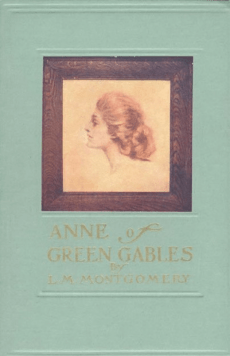
Rereading Anne of Green Gables by L.M. Montgomery

(You can listen to this episode here.)

Deborah and Mary Grace discuss Anne of Green Gables, L.M. Montgomery’s beloved tale of a strong-willed and imaginative orphan who goes to live with a pair of middle-aged siblings on Prince Edward Island.

Other books in the series:

Anne of Avonlea

Anne of the Island

Anne of Windy Poplars

Anne’s House of Dreams

Anne of Ingleside

The recently published book of stories Deborah mentions is The Blythes are Quoted.

Also mentioned on the episode:

Mary Grace read Anne of Green Gables during her year of reading as if she were living in 1918 and reviewed it here. It’s #37 on the list.

Anne is a prodigious reader. Here are some of the books and poems that she reads:

“Curfew Must Not Ring Tonight” by Rose Hartwick Thorpe

“The Lady of Shallot” by Alfred, Lord Tennyson. Mary Grace misquotes the poem, saying “The mirror crack’d from side to side/the DOOM has come upon me, cried/The Lady of Shallot,” instead of “the CURSE has come upon me,” repeating a misquotation by a character in Agatha Christie’s The Mirror Crack’d.

Ben Hur by Lew Wallace

“Marmion” by Sir Walter Scott

Mary Grace mentions the attractive Word Cloud Classics edition of Anne of Green Gables, which she read in 2018. Alas, the print was too small this time around, so she read it on her Kindle.

You can see the original illustrations by William and Mary Claus, which neither Deborah nor Mary Grace are a fan of, in this scanned copy on HathiTrust.

“Suicide Secret of Anne of Green Gables Author,” The Guardian, September 23, 2008.

Trailer for Netflix series Anne With an E

Little Women by Louisa May Alcott

Recommended by Mary Grace for fans of Anne of Green Gables: Pippi Longstocking by Astrid Lindgren

Recommended by Deborah for fans of Anne of Green Gables: Rebecca of Sunnybrook Farm by Kate Douglas Wiggin, Caddie Woodlawn by Carol Ryrie Brink

“Bosom Friends: Lesbian Desire in L. M. Montgomery’s Anne Books,” Laura Robinson, Canadian Literature, Spring 2004

“A Visual History of Romantic Friendship,” The Marginalian

The podcast is hosted by Buzzsprout at rereadingourchildhood.buzzsprout.com and is available on SpotifyApple Podcasts, and other podcast platforms.

You can find Deborah’s author interviews on her blog, Books Q&A by Deborah Kalb, and Mary Grace’s adventures in the 1920s on her blog, My Life 100 Years Ago.

This episode was edited by Adam Linder of Bespoken Podcasting.
Our Favorite Children’s Books from 50 Years Ago

(You can listen to this episode here.)

Mary Grace and Deborah ring in 2024 with a special episode where they count down their five favorite books from 50 years ago, defined as published between 1972 and 1974. They (mostly) didn’t reread these books for the episode, so their choices are based on their childhood memories.

As Mary Grace mentions, the format was inspired by the Book Riot podcast, which has done a number of similar countdowns, including a fun episode on the top bookish phenomena of the past 25 years.

Here are Deborah’s and Mary Grace’s favorites–but we suggest that you listen to the episode before looking at the list!

Deborah’s Favorites

5. Nobody’s Family is Going to Change by Louise Fitzhugh
4. A Billion for Boris by Mary Rodgers
3. Victoria by Barbara Brooks Wallace
2. The Genie of Sutton Place by George Selden
1. A Proud Taste for Scarlet and Miniver by E.L. Konigsburg

Mary Grace’s Favorites

5. A Wind in the Door by Madeleine L’Engle
4. Dinky Hocker Shoots Smack! by M.E. Kerr
3. Glory in the Flower by Norma Johnston
2. A Billion for Boris by Mary Rodgers
1. The Dark is Rising by Susan Cooper

You can find Deborah’s author interviews on her blog Books Q&A by Deborah Kalb and Mary Grace’s adventures in the 1920s on her blog, My Life 100 Years Ago.

This episode was edited by Adam Linder of Bespoken Podcasting.
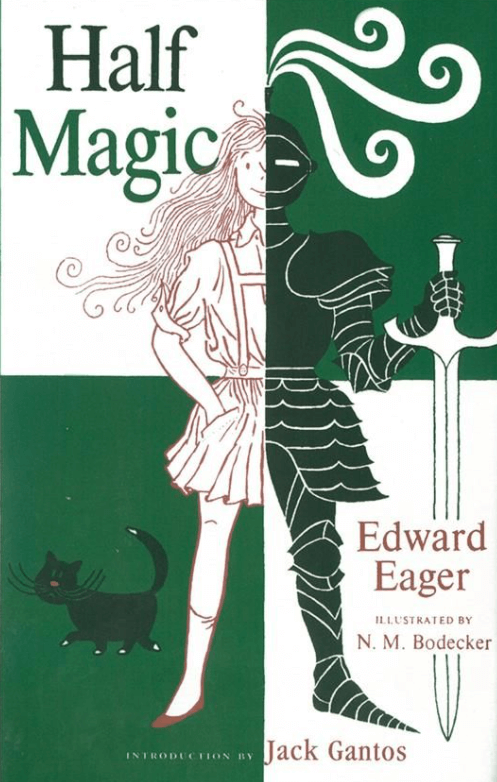
Rereading Half Magic by Edward Eager

You can listen to this episode here.

In this episode, Mary Grace and Deborah discuss Edward Eager’s Half Magic, the first of Eager’s seven books of magical adventures. Four bored siblings living in a Midwestern city in the 1920s find a magic amulet…except it only grants half of what you wish for. We talk about what has and hasn’t held up in the seven decades since Half Magic was published, about Eager’s life, and about the obscure jokes Eager threw in to entertain himself.

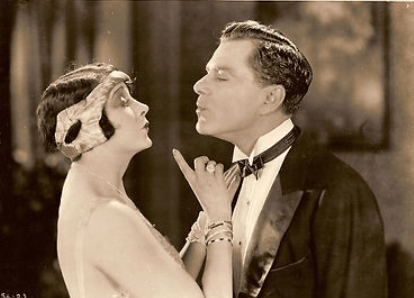
The Half Magic children go to see Sandra, a 1924 silent movie (now lost) starring Barbara La Marr. As Mary Grace discusses on the podcast, this movie is not at all appropriate for children. Here’s a still, and you can read the review from Moving Picture World, which didn’t like the move any more than the children did, here.

Barbara La Marr and Bert Lytell in “Sandra”

As Mary Grace mentions, Edward Eager had a career in show business as well as being a children’s writer. You can listen to this YouTube recording of Peggy Lee singing “Good-Bye, John,” lyrics by Eager, and decide whether you agree with her that he was more talented as a writer than as a lyricist.

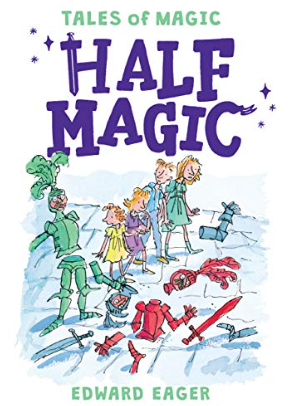
The original cover of Half Magic appears at the top of the post. Mary Grace and Debby were a bit alarmed by the illustration chosen for the current paperback edition (not by original illustrator N.M. Bodecker), which features two knights who have been chopped into pieces. (Don’t worry, they don’t remain in this state for long.)

Here are links to other books Debby and Mary Grace recommend for fans of Half Magic.

Recommended by Mary Grace (not just because Debby wrote them! They’re wonderful books!):
George Washington and the Magic Hat, by Deborah Kalb
John Adams and the Magic Bobblehead, by Deborah Kalb
Thomas Jefferson and the Return of the Magic Hat, by Deborah Kalb

Recommended by Debby:***
The Time Garden, by Edward Eager
Time Cat: The Remarkable Journeys of Jason and Gareth, by Lloyd Alexander
Tom’s Midnight Garden, by Philippa Pearce
A Traveller in Time, by Alison Uttley
A Wrinkle in Time, by Madeleine L’Engle

Debby’s post on these books appeared on the website shepherd.com.

You can find Debby’s author interviews on her blog Books Q&A by Deborah Kalb and Mary Grace’s adventures in the 1920s on her blog, My Life 100 Years Ago.

This episode was edited by Adam Linder of Bespoken Podcasting.
Rereading Caddie Woodlawn by Carol Ryrie Brink

(You can read this episode here.)

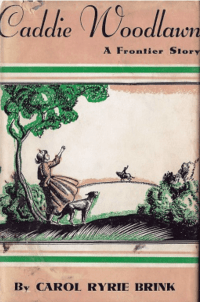
On this episode, Deborah and Mary Grace read Carol Ryrie Brink’s 1935 Newbery Medal winner Caddie Woodlawn, which is based on Brink’s grandmother’s childhood adventures on the Wisconsin frontier.

Mentioned on this episode:

Caddie Woodlawn’s Family by Carol Ryrie Brink (previously titled Magical Melons) (1939)

Two Are Better Than One by Carol Ryrie Brink (1968)

Louly by Carol Ryrie Brink (1974)

Mary Grace mentioned what she thought were two different blog posts on a website about portrayals of American Indians in children’s books. Actually, it was just one post, here.

The Birchbark House by Louise Erdrich (1999)

The Little House books by Laura Ingalls Wilder

The podcast is hosted by Buzzsprout at rereadingourchildhood.buzzsprout.com and is available on SpotifyApple Podcasts, and other podcast platforms. You can listen to it on Buzzsprout here.

You can find Debby’s author interviews on her blog, Books Q&A by Deborah Kalb, and Mary Grace’s adventures in the 1920s on her blog, My Life 100 Years Ago.

This episode was edited by Adam Linder of Bespoken Podcasting.