On this episode, Deborah and Mary Grace discuss Danny Dunn and the Anti-Gravity Paint, published in 1956. In the first book of the popular series, Danny discovers a secret rocket project and, oops, accidentally launches the rocket into space.
As Deborah mentions, Danny Dunn and the Anti-Gravity Paint was illustrated by Ezra Jack Keats, who wrote and illustrated the Caldecott Award-winning picture book The Snowy Day.
For fans of Danny Dunn, Mary Grace recommends the Henry Reed series. We discussed Henry Reed, Inc., the first book in the series, on our third episode. Deborah recommends the Encyclopedia Brown books. The first book in the series, Encyclopedia Brown, Boy Detective, was discussed on our eighth episode.
On this episode, Deborah and Mary Grace discuss Ballet Shoes, Noel Streatfeild’s classic 1936 story of a trio of adopted sisters, Pauline, Petrova, and Posy, who attend a school for professional children in the performing arts in London. Ballet Shoes is the first in what became a series of “Shoes” books about children working in the theater, the circus, etc.
As Deborah and Mary Grace mention, the girls perform in these plays:
The Blue Bird, by Maurice Maeterlinck (a large chunk of which, weirdly, appears in the text of Ballet Shoes)
Other Noel Streatfeild books mentioned in the podcast:
Circus Shoes (1938). As Deborah mentions, several of Streatfeild’s books were retitled to capitalize on the popularity of Ballet Shoes. This book was originally titled The Circus is Coming.
Skating Shoes(1951). This is the American title; it was published in the UK as White Boots.
The Whicharts (1931). As Deborah mentions, Streatfeild’s first novel, which is for adults, also features three adopted sisters. (According to an episode on Ballet Shoeson the wonderful Backlisted podcast, the books have identical openings.)
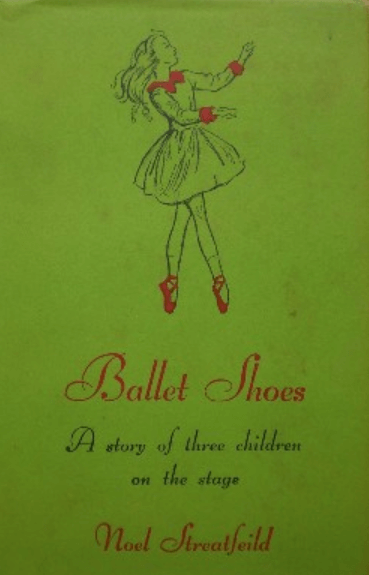
Here’s the cover of the first edition of Ballet Shoes. This will give you an idea of the what the illustrations by Ruth Jervis, who was Streatfeild’s sister, were like. They’re not included in most current editions, although the Puffin edition that Mary Grace bought in London has them.
Recommended by Mary Grace for fans of Ballet Shoes: We Danced in Bloomsbury Squareby Jean Estoril (out of print, available from used booksellers).
Recommended by Deborah for fans of Ballet Shoes: other books in the Shoes series. Shoes books available in the United States include Theater Shoes and Dancing Shoes.
The podcast is hosted by Buzzsprout at rereadingourchildhood.buzzsprout.com and is available on Spotify, Apple Podcasts, and other podcast platforms. You can listen to it on Buzzsprout here.
In the first episode of Rereading Our Childhood, Mary Grace and Deborah revisit Are You There God? It’s Me, Margaret, Judy Blume’s classic 1970 novel about adolescence. You can listen to this episode here.
Are You There God? It’s Me, Margaret is narrated by Margaret, a sixth-grader who has just moved from New Jersey to New York. Margaret’s father is Jewish and her mother was brought up Christian and she is being raised without a religion, which leaves her wondering where she fits in. Meanwhile, she and her friends are preoccupied with bras and boys and are eagerly waiting to get their periods. In this episode, Mary Grace and Deborah discuss the impact of Are You There God? It’s Me, Margaret and Blume’s other books on their own adolescent selves and how the book held up on rereading. They also talk about the Judy Blume moment currently underway, with a feature film of Are You There God? It’s Me, Margaret and the Amazon Prime documentaryJudy Blume Foreverrecently released, and about Blume’s activism against book banning.
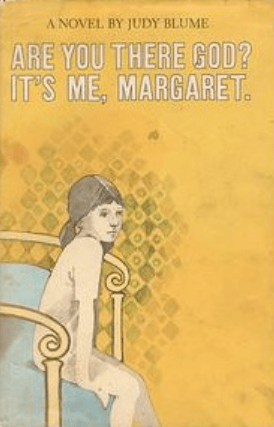
As Mary Grace and Deborah discuss, different covers over the years have presented Margaret in different ways, from the pensive girl sitting on her bed on the original edition,
to the blond Margaret on the 1970s paperback edition, who looks nothing like the Margaret in the book,
to the current paperback edition, where Margaret is anachronistically texting God on a cellphone (and he seems to be writing back),
to the movie tie-in with Margaret adjusting her shoe, presumably from the scene where she gets blisters walking to school without socks after her awful friend Nancy tells her that no one in sixth grade wears them.
Forever, the much-banned book about a teenage sexual relationship
As Mary Grace and Deborah discuss, Judy Blume’s books are often banned. An April 2023 PEN America report includes Blume’s novel Forever… on a list of books that have recently been removed from school libraries in the United States.
Here’s the New York Times article Mary Grace mentioned about the Judy Blume book-to-screen moment currently underway. (Clarification: It’s from the business section.)
As Mary Grace notes, Judy Blume demonstrated the famous “I must, I must, I must increase my bust” exercise on a TV program (HuffPost Live).
Recommended for fans of Are You There God? It’s Me, Margaret:
Freaky Fridayby Mary Rodgers, the hilarious story of a New York teenager who wakes up and discovers she’s been turned into her mother
The Long Secret by Louise Fitzhugh, the sequel to Harriet the Spy and one of the few books from the era other than Are You There God? It’s Me, Margaret to feature a girl getting her first period
If you haven’t had enough discussion of Margaret’s adolescent travails, there’s a great segment on the book on First Edition, a new podcast from the always interesting Book Riot team. They also have a substack critiquing the book’s covers.




 Rereading Our Childhood