Category Archives: 1960s

Rereading The Egypt Game by Zilpha Keatley Snyder

(You can listen to this episode here. Please note that it is not suitable for children due to discussion of violent incidents that take place in the book.)

On this episode, Mary Grace and Deborah discuss The Egypt Game, Zilpha Keatley Snyder’s 1967 Newbery Honor Book about a group of children in a California university town who create an elaborate game based on ancient Egypt.

Mentioned in this episode:

The Egypt Game: A Second Look, a 50-year retrospective published in The Horn Book in 2017

The 1967 Kirkus Review review of The Egypt Game

A 2011 post on the website Banned Reads Project where three teenagers give their perspectives on The Egypt Game

The ACLU’s list of The 100 Most Frequently Challenged Books of 1990-2000

The Waste Land by T.S. Eliot

The Love Song of J. Alfred Prufrock by T.S. Eliot

Other Rereading Our Childhood episodes:

Rereading Are You There God? It’s Me, Margaret by Judy Blume

Rereading Jennifer, Hecate, Macbeth, William McKinley, and Me, Elizabeth by E.L. Konigsburg

Rereading A Wrinkle in Time by Madeleine L’Engle

Rereading Half Magic by Edward Eager

Rereading The Owl Service by Alan Garner

Our Favorite Children’s Books from 50 Years Ago

Other books by Zilpha Keatley Snyder:

The Gypsy Game, the 1997 sequel to The Egypt Game

The Headless Cupid (1971), a Newbery Honor Book

The Witches of Worm (1972), a Newbery Honor Book

The Changeling (1970)

Eyes in the Fishbowl (1968)

Black and Blue Magic (1966)

Season of Ponies (1964)

Recommended for fans of The Egypt Game:

Jennifer, Hecate, Macbeth, William McKinley, and Me, Elizabeth, by E.L. Konigsberg (1967 Newbery Honor Book)

From the Mixed-Up Files of Mrs. Basil E. Frankweiler by E.L. Konigsburg (1967 Newbery Medal winner)

Magic or Not? by Edward Eager

The Well-Wishers by Edward Eager

The podcast is hosted by Buzzsprout at rereadingourchildhood.buzzsprout.com and is available on SpotifyApple Podcasts, and other podcast platforms.

You can find Debby’s author interviews on her blog, Books Q&A by Deborah Kalb, and Mary Grace’s adventures in the 1920s on her blog, My Life 100 Years Ago.

This episode was edited by Adam Linder of Bespoken Podcasting.

Rereading Little Witch and The Little Leftover Witch

(You can listen to this episode here.)

Deborah and Mary Grace celebrated Halloween by reading two books about witches, Little Witch by Anna Elizabeth Bennett, which was published in 1953, and The Little Leftover Witch by Florence Laughlin, which was published in 1960. Both books are about lonely little witches who find homes with non-magical families. Deborah had read both books as a child; both were new to Mary Grace.

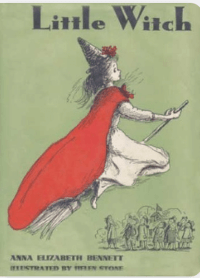
Here’s the original cover of The Little Witch, with illustrations by Helen Stone. Two of Stone’s other books were selected as Caldecott Honor Books.

Here’s the original cover of The Little Leftover Witch, which gives you some idea of the illustrations by Sheila Greenwald, which Debby enjoyed as a child and missed in the current edition, which doesn’t have illustrations.

Other witch-related books mentioned on the episode:

The Witch of Blackbird Pond by Elizabeth Speare (1958)

The Active Enzyme Lemon-Freshened, Junior High School Witch by E. W. Hildick (1973)

The Wizard of Oz books by L. Frank Baum

The Harry Potter books by J.K. Rowling

And, finally, Jennifer, Hecate, Macbeth, William McKinley, and Me, Elizabeth by E. L. Konigsburg, which was featured on our second episode.

The podcast is hosted by Buzzsprout at rereadingourchildhood.buzzsprout.com and is available on SpotifyApple Podcasts, and other podcast platforms. You can listen to it on Buzzsprout here.

You can find Debby’s author interviews on her blog, Books Q&A by Deborah Kalb, and Mary Grace’s adventures in the 1920s on her blog, My Life 100 Years Ago.

This episode was edited by Adam Linder of Bespoken Podcasting.
Rereading A Wrinkle in Time by Madeleine L’Engle

(You can listen to this episode here.)

On this episode, Mary Grace and Deborah reread Madeleine L’Engle’s 1962 classic A Wrinkle in TIme, about…well, it’s hard to describe what it’s about. A troubled girl. A missing father. A genius brother. Three mysterious women. Interplanetary adventure. An evil, throbbing brain. None of this does justice to a book that two science fiction-hating girls ended up loving, and that their grown-up selves had a wonderful time returning to.

Here’s the original cover, which perfectly captures its Cold War atmosphere:

Mentioned on this episode:

Listening for Madeleine, Leonard Marcus’s book of interviews with people in L’Engle’s life.

Cynthia Zarin’s controversial 2004 New Yorker profile of L’Engle.

The ALA website listing the 100 most challenged books of the 1990s, with A Wrinkle in Time at #23.

The recent PEN America report on book banning in the United States.

A 2001 New York Times interview with L’Engle.

The trailer to the 2018 movie version of A Wrinkle in Time.

The Paris Review blog post where Mary Grace read that Madeleine L’Engle rewrote her novel A House Like a Lotus to give it a new protagonist.

The podcast is hosted by Buzzsprout at rereadingourchildhood.buzzsprout.com and is available on Spotify, Apple Podcasts, and other podcast platforms. You can listen to it on Buzzsprout here.

You can find Debby’s author interviews on her blog, Books Q&A by Deborah Kalb, and Mary Grace’s adventures in the 1920s on her blog, My Life 100 Years Ago.

This episode was edited by Adam Linder of Bespoken Podcasting.
Rereading The Great Brain by John D. Fitzgerald

You can listen to this episode here.

On this episode, Deborah and Mary Grace read John D. Fitzgerald’s 1967* novel The Great Brain, the first book in the series featuring John, the narrator, and his older brother Tom, the eponymous Great Brain, who wreaks havoc on their late 19th-century Utah town with his devious moneymaking ventures. Mary Grace, who did not read this book as a child, suspects that this sometimes harrowing read is Deborah’s revenge for making her read The Owl Service.

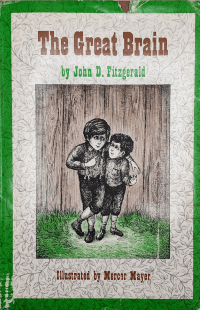
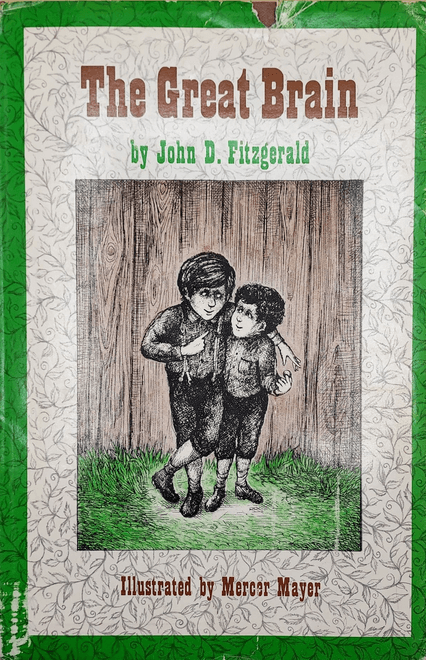
The first edition cover gives a good sense of Mercer Mayer’s illustrations.

Here’s the Amazon review Mary Grace mentions that gives parents a heads-up about disturbing content in the book.

Mary Grace recommends the Encyclopedia Brown books, featured on a previous episode, for fans of The Great Brain. She also recommends Two Are Better than One and Louly, by Carol Ryrie Brink, which are set in a small Idaho town in the early 20th century. Deborah recommends the Henry Reed series, also featured on a previous episode.

Here’s a June 2023 article by New York Times opinion writer Carlos Lozada, who was born in Peru, about his love for The Great Brain, which he read after his family moved to the United States. Lozada jumps into the article’s comments section to share more Great Brain love with readers.

The podcast is hosted by Buzzsprout at rereadingourchildhood.buzzsprout.com and is available on SpotifyApple Podcasts, and other podcast platforms.

You can find Deborah’s author interviews on her blog, Books Q&A by Deborah Kalb, and you can find Mary Grace’s adventures in the 1920s on her blog, My Life 100 Years Ago.

This episode was edited by Adam Linder of Bespoken Podcasting.

*Mary Grace says incorrectly that it was published in 1969.

Rereading The Owl Service by Alan Garner

You can listen to this episode here.

In this episode, Mary Grace and Deborah reread Alan Garner’s Carnegie Medal-winning 1967 novel The Owl Service, which tells the story of three teenagers, Alison, Gwyn, and Roger, who find themselves reliving a Welsh legend of love and betrayal. Word to the wise: read it, but not right before bed like Mary Grace did!

The Owl Service has had many editions, and many covers, over the years. Here’s the first-edition cover.

Here’s the current edition that Mary Grace and Deborah read this time around, except it’s much cooler-looking in real life because what looks orange in the photo is actually a shiny copper color.

Here’s a cheesy horror movie-style cover:

And another one:

Here’s a 2021 Guardian profile of Garner.

Mary Grace recommends Lloyd Alexander’s The Chronicles of Prydain series and Susan Cooper’s The Dark is Rising series for fans of The Owl Service.

At the beginning of the book, Alison becomes obsessed with a set of dinner plates with pictures of owls or flowers, depending on how you look at them. As Mary Grace mentions, the plates in the book were inspired by a real-life set that Garner saw at someone’s house. She rashly promised to put a photo of the plates on the website, but it turns out that it’s copyrighted. You can see it at the Bodleian Libraries‘ Facebook page.

The podcast is hosted by Buzzsprout at rereadingourchildhood.buzzsprout.com and is available on Spotify, Apple Podcasts, and other podcast platforms. You can listen to it on Buzzsprout here.

You can find Debby’s author interviews on her blog, Books Q&A by Deborah Kalb, and Mary Grace’s adventures in the 1920s on her blog, My Life 100 Years Ago.

This episode was edited by Adam Linder of Bespoken Podcasting.

Rereading Encyclopedia Brown, Boy Detective by Donald J. Sobol

You can listen to this episode here.

Encyclopedia Brown, Boy Detective, which was published in 1963, is the first of Donald J. Sobol’s 29-book series featuring Encyclopedia, the boy detective who always gets his man (or boy, or girl). The solution to each crime is revealed at the end of the book. In this episode, Deborah and Mary Grace match wits with Encyclopedia, and with each other, in identifying the culprits.

Here’s the cover of the first edition. The current edition has a different cover but still features the original illustrations by Leonard Shortall, who went on to illustrate many other Encyclopedia Brown books.

You can find the full Encyclopedia Brown series on Goodreads.

You can find Two-Minute Mysteries, a collection of Sobol’s syndicated columns for adults, here.

Sobol’s New York Times obituary, published on July 16, 2012, is here.

Mary Grace recommends the Danny Dunn books for fans of Encyclopedia Brown. Clarifications: Danny Dunn does not, in fact, go to the moon, as Mary Grace thought he might have, but he does go to outer space in Danny Dunn and the Anti-Gravity Paint. Also, the scientist in the book is not his uncle but his mother’s employer, Professor Bullfinch.

Deborah recommends the Henry Reed books for Encyclopedia fans. We discussed Henry Reed, Inc. on the third episode of Rereading Our Childhood.

The podcast is hosted by Buzzsprout at rereadingourchildhood.buzzsprout.com and is available on SpotifyApple Podcasts, and other podcast platforms. You can listen to it on Buzzsprout here.

You can find Deborah’s author interviews on her blog, Books Q&A by Deborah Kalb, and you can find Mary Grace’s adventures in the 1920s on her blog, My Life 100 Years Ago.

This episode was edited by Adam Linder of Bespoken Podcasting.
Rereading Harriet the Spy by Louise Fitzhugh

Mary Grace and Deborah discuss Harriet the Spy, Louise Fitzhugh’s 1964 classic about an 11-year-old would-be writer, her spying career, and her interactions with her nanny, her classmates, and her parents. You can listen to the episode here.

Other books in the series:

The Long Secret (1965)

Sport (1979, published posthumously)

Fitzhugh’s first book was Suzuki Beane, a parody of Eloise, written by Sandra Scoppettone and illustrated by Fitzhugh.

We also discuss Fitzhugh’s book Nobody’s Family Is Going to Change (1974).

Here’s Deborah’s Q&A with Leslie Brody, author of the Fitzhugh biography Sometimes You Have to Lie (2020).

You can find information on the animated TV series of Harriet the Spy and a link to the (free) first episode at Rotten Tomatoes here.

The review of the Harriet the Spy animated series that Mary Grace mentioned is here.

If you enjoyed Harriet the Spy, you might also like From the Mixed-Up Files of Mrs. Basil E. Frankweiler, by E.L. Konigsburg (1967). Older kids might be interested in the work of author M.E. Kerr.

The New Yorker article Mary Grace discusses about Louise Fitzhugh is here.

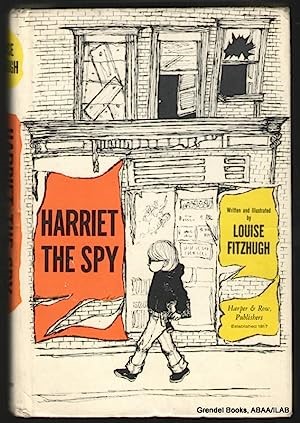
Here’s the original hardback cover of Harriet the Spy.

Here’s the classic paperback cover, which we discuss in this episode:

The podcast is hosted by Buzzsprout at rereadingourchildhood.buzzsprout.com and is available on Spotify, Apple Podcasts, and other podcast platforms. 

You can find Deborah’s author interviews on her blog, Books Q&A by Deborah Kalb, and Mary Grace’s adventures in the 1920s on her blog, My Life 100 Years Ago.

This episode was edited by Adam Linder of Bespoken Podcasting.

Rereading Jennifer, Hecate, Macbeth, William McKinley, and Me, Elizabeth by E.L. Konigsburg

In the second episode of Rereading Our Childhood, Debby and Mary Grace reread Jennifer, Hecate, Macbeth, William McKinley, and Me, Elizabeth, E.L. Konigsburg’s 1967 debut novel. You can listen to this episode here.

Jennifer, Hecate… is narrated by Elizabeth, a fifth grader who has just moved to a suburb of New York. She has no friends until she meets Jennifer, who says she’s a witch and offers to train Elizabeth as her apprentice. A series of challenges ensues (one week, for example, Jennifer has to eat a raw onion every day), and Elizabeth also faces the more common challenges of dealing with her teachers and classmates. In this episode, Debby and Mary Grace discuss witchcraft, race, childhood friendships, and the pronunciation of “Hecate.”

Konigsburg’s second novel, From the Mixed-Up Files of Mrs. Basil E. Frankweiler, was also published in 1967. It won the Newbery award in 1968, and Jennifer Hecate… was a runner-up. She is the only writer ever to have won both honors in the same year.

Debby and Mary Grace mentioned these other books by E.L. Konigsburg:

From the Mixed-Up Files of Mrs. Basil E. Frankweiler, Konigsburg’s Newbery Award winner about a brother and sister who run away to the Metropolitan Museum.

(George), about a boy in Florida who thinks that a little man named George lives in his head.

A Proud Taste for Scarlet and Miniver, the life of medieval queen Eleanor of Aquitaine as narrated by people close to Eleanor as they wait for her to join them in heaven.

About the B’nai Bagels, about a Jewish boy whose mother coaches his baseball team.

Kongisburg and her family were living in the suburban town of Port Chester, New York, when she write Jennifer, Hecate. The town Jennifer and Elizabeth live in is based on Port Chester. As Mary Grace mentioned, Konigsburg’s children faced harassment because they were Jewish. Laurie Konigsburg Todd, discusses this in an interview in a Smithsonian Magazine article commemorating the fiftieth anniversary of From the Mixed-Up Files.

Here are some covers of various editions of Jennifer, Hecate:

This is the 50th anniversary edition, which replicates the first edition cover.

This is the cover of the paperback edition Debby and Mary Grace read as children (they both still have their copies), featuring Jennifer, Elizabeth, and their toad, Hillary Ezra.

This is the cover of a recent paperback edition, which, as Mary Grace mentioned, has been criticized for “erasing” Jennifer, who is African-American.

Here’s a Puffin edition with the abridged British title.

Mary Grace mentioned that a well-known British author criticized E.L. Konigsburg’s long titles. The author, John Rowe Townsend, is quoted in this article as calling the titles “gimmicky” and “an irritation” .

Here are the books that Debby and Mary Grace recommended for fans of Jennifer Hecate:

The Egypt Game, by Zilpha Keatley Snyder, about a group of children in Berkeley, California, who perform ancient Egyptian rituals. Is it just a game, or something more?

Harriet the Spy, by Louise Fitzhugh, the classic story of Manhattan girl who spies on her neighbors and records her observations about them, and about her classmates, in her journal.

And, lastly, here’s Merriam-Webster’s definition of Hecate, with pronunciations. Bottom line: Debby and Mary Grace are both right!

The podcast is hosted by Buzzsprout at rereadingourchildhood.buzzsprout.com and is available on Spotify, Apple Podcasts, and other podcast platforms.

You can find Debby’s author interviews on her blog, Books Q&A by Deborah Kalb and Mary Grace’s adventures in the 1920s on her blog, My Life 100 Years Ago.

This episode was edited by Adam Linder of Bespoken Podcasting.